
ROX-TV delivers your Halloween Fix a few months early. Tonight we discuss and highlight Vintage Halloween costumes. An ongoing series.
Welcome back to the ROX-TV website. As you know we are some of the biggest fans of Halloween in the Midwest. Every year the sky turns gray, the leaves turn colors, and the cold chill blows in. Michigan is ground zero for the full experience and celebrates a rich history with the holiday, which is festive and also has some historically unique features. From Trick or Treating to Devil’s Night Fires, Michigan seems to have a little something for everyone.
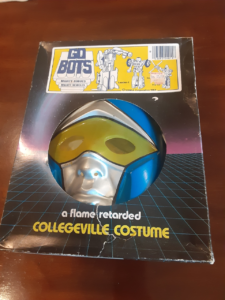 This series will be featuring some of my favorite aspects of the holiday and that is the costumes that are worn each year, with a particular in-depth dive into the past. I was born in 1980 and the costumes of the day were as colorful as the season and usually related to what was hot in American culture at the time for the children.
For this flagship series, we will be jumping off with a costume highlight from my childhood. The “Go-Bots” were pretty fire during the mid to late eighties and I have a vintage costume that I think some of you will remember. These costumes are also highly collectable and I’ve managed to stash away some good ones over the years. This article will resonate with people interested in Halloween, the collectors of course, and anyone who holds the magical season in high regard. So without further to do, I give to you the “G0-Bot” costume.
Go-Bots costume and background:
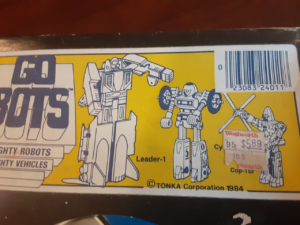 Go-bots were released by Tonka in 1983 and a year before Transformers. Originally based of figures by Popy of Japan, Machine Robo, Go-Bots were robot that didn’t need to be piloted by humans, like Voltron. They were robot sentients and had two categories: good and evil. I remember when Go-Bots got going around 1984-1985 and enjoyed the cartoons which aired during that time period. In all, 65 episodes were created and had a run time of twenty two minutes each.
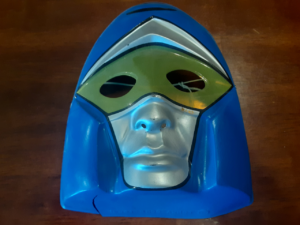 In 1987, the toy line introduced their last new characters. By 1991 Hasbro had acquired Go-Bots from Tonka. From that point the Go-Bot world became part of the Transformers multiverse. In an odd twist, Hasbro owned the storyline and characters bio’s, but did not receive the rights to the toys. Bandai retained those but is now defunct. It seems it was easier for the Transformers to buy out the competition and put them on virtual ice.
Costume:
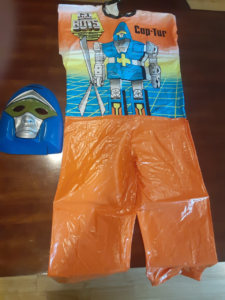 This is a pretty good example of a classic Collegeville boxed Halloween costume and in fairly good shape. Even better is the actual price tag from Woolworth’s, listing the price at $5.89 cents. The box is in decent shape minus a tear on the front. Also missing is the plastic “windshield” where kids could actually see what the costume was. I also say, yes damage is never good, but other factors to take in consideration is the availability, scarcity, and market price. Although I would rather have a box without damage, when you can’t find another one on ebay, then I give less credence to the imperfections.
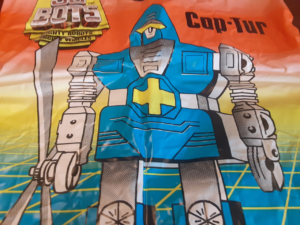 Sign of the times: Back when this costume was produced, maker’s wanted them to seem as safe as possible. It seemed that each year brought another horror story of a child being burnt in the next town over. As with the myth of the tampered candy, I never met anyone who every got burned in a flammable plastic suit. Nor had I ever met anyone who bit into a razor blade candy either. But safety was always a “good selling point” and that can be highlighted no greater than the official decree that the costume is “FLAME RETARDED”. In this day in age, those words would get a product banned but things were different back then. One of the most used names on the playground during the mid to late eighties “retard” was a basic response to any one a person did not like and was used from coast to coast.
Availability:
 Last year there were three Go-Bots costumes for sale. But due to collectability and demand, as of 4/18/22…there are none on Ebay. Along with Cop-Tur, there was also a Leader-1 and a Cy-Kill costume available but no longer. They were listed between $29 to $49 dollars. There are times when I haven’t been able to find any on Ebay and for collectors, here today, gone tomorrow is a very real possibility. I believe the prices to be reasonable and could fetch considerably more if the buyer is a true Go-Bots fan or someone looking to own a piece of their childhood again. Since last year, I can only expect the prices to rise though and with each year passing, they become more sought after and considerably more rare (due to frailty and age). If you find one, pull the trigger because there’s a good chance if you don’t, you might not see one again. These costumes from the 1980’s are becoming harder to locate in any condition, especially with the box intact.
Michigan Connection
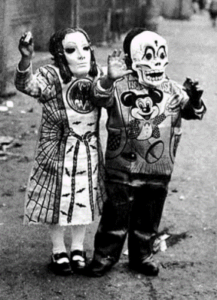
Now with Samhain and Halloween only a few months out, I think it is a good time to reflect on the holiday and the impact it has had on modern culture and horror movies. Coming from Michigan it can be said that Halloween and imagery/folklore has bled into the local music, going back to the late eighties and early nineties. No one can forget the Insane Clown Posse’s contribution to the holiday music and season, and I suggest anyone hasn’t delved into the topic, do so at their earliest convenience. The Hallowicked series is engrained in the culture of Detroit rap music and has been celebrated since the 1990’s.
Perhaps it is the season’s change in Michigan or the massive influx of Irish immigrants who settled in Detroit due to the great potato famine, whatever the reason, Halloween seems to be heavily celebrated in our state culture and indie music scene
Samhain
Samhain is an ancient Gaelic Festival marking the end of the harvest season. The festival was historically linked to the Irish and Scottish, with what is believed to have Celtic Pagan origins. In Ireland, there are ancient tombs which are aligned with the sunrise times of Samhain. The time can be traced back to 9th century writings of some of the earliest Irish Literature.
Those early writings about Samhain talk about large feasts and gatherings happening, along with the ancient burial tombs being opened. These mounds were seen as gateways to the underworld and large fires are associated with the celebrations. The livestock were brought down from pastures and slaughtered. The bonfires were believed to have cleansing and protective powers. Samhain was reported to be a festival where the lines between the living and dead became very narrow. With this thinning of time, it was believed that spirits and fairies could cross over into our world of the living rather easily.
During Samhain, these entities were offered food and drink to appease them, so that the people could survive the winter months. The early Irish and Scots also believed that their deceased family members could revisit their homes, so a place at the dinner table was set for them. During the early times of the modern recorded era, it was said that people and children would go door to door in disguises or costumes, reciting versus for food.
In the 9th Century, the Catholic Church declared November 1st as “All Saint’s Day” and November 2nd as “All Soul’s Day”. Over time, these dates influenced Samhain, causing them to slowly transform each other into America’s modern Halloween.
Wiccans celebrate a variation of Samhain each year and has been said to be one of their most important times during the “Wheel of the year”. Wiccans generally believe that Samhain is a time to celebrate and honor deceased family, friends, pets, elders of their faith, and ancestors long passed. In some Wiccan rituals, the dead are invited to the festivities. The Wiccans believe the boundary between the living and dead is the closest during Samhain, making communication with the dead much easier.
Modern Halloween
The word “Halloween” can be dated to around the mid 1700’s and is said to be Christian in origin. November 1st was declared “All Hallows Day” or “All Saint’s Day” (Hallowmas) and eventually October 31st was coined “All Hallows Eve”. Included with “All Souls Day” on November 2nd, these three days together were known as “Allhallowtide”.
It is believed that modern day trick-or-treating developed from these days of holy obligation, where bells were rung for the souls trapped in purgatory, the town criers would walk in the streets dressed in black, ringing a hand bell, and asking that the souls be remembered. The baking and sharing of “soul cakes” which dates back to at least the 15th century, has been partially credited with the modern day idea of trick or treating. During the time of “Allhallowtide” groups of adults and children would go door to door collecting soul cakes in exchange for praying for the deceased. Soul cakes were often marked with a cross and considered Alms (Alms: money, food, or material given to the poor in the name of charity and virtue).
Costumes may have been a way of people disguising themselves, when the dead walked the earth and were given one last chance to wreak vengeance on their enemies during “All Hallows Eve” (Suggested by Christian minister Prince Sorie Conteh). To avoid payback from the dead, people used to disguises to avoid detection. In the middle ages, Churches that didn’t have enough money to house “relics” of the martyred saints, would allow their parishioners to dress up as saints during “Allhallowtide”. There are scholars who believe these things were done to “Christianize” the Pagan holidays.
While out “souling”, people would often carry hollowed out turnips as lanterns. I guess you can see where the groundwork was laid out for the modern day Jack-O-Lantern. During Halloween in medieval Europe, the fires were seen as a beacon for the dead to find their homes and also a way to deflect evil spirits. It was common in England, Ireland, and parts of Europe to light candles in every room to guide their ancestors back to their earthly homes.
Halloween in America
Halloween was not widely celebrated in America, until the massive influx of immigrants from Ireland and Scotland during the late 18th and early 19th century. Halloween (Samhain) was confined to immigrant communities until the mid 19th century, before gradually becoming a mainstream holiday celebrated from coast to coast by all races, social structures, and religious backgrounds. In Ireland and Scotland, turnips were carved, but in North America the native pumpkin was used because it was larger and easier to carve. Carving pumpkins in America is said to be dated back to 1837 but was not specifically associated with Halloween until the mid to late 19th century. The modern images of Halloween come from many sources.
Michigan Connection
Now that we are looking to the season of fall, with Samhain and Halloween coming for us, I think it is a good time to reflect on the holiday and the impact it has had on modern culture and horror movies. Coming from Michigan it can be said that Halloween and imagery/folklore has bled into the local music, going back to the late eighties and early nineties. No one can forget the Insane Clown Posse’s contribution to the holiday music and season, and I suggest anyone hasn’t delved into the topic, do so at their earliest convenience. The Hallowicked series is engrained in the culture of Detroit rap music and has been celebrated since the 1990’s.
Perhaps it is the season’s change in Michigan or the massive influx of Irish immigrants who settled in Detroit due to the great potato famine, whatever the reason, Halloween seems to be heavily celebrated in our state culture and indie music scene.
Well that about does it for this one, keep coming back for dope content and the continuing Halloween costume series. Thanks to everyone that came along for the ride and especially those whose gaze is permanently set on October. I’m with you all the way. 333/369/3:33
Signing Off,
Mike Shepard
ROX-TV Head Writer
shepard2909@hotmail.com